

The Solar Quandry

Updated: Apr 23

The modern world spent years handing its hope to dashboards, subscriptions, litigation portals, and customer-service loops with recorded piano under them. If a civilization insists on turning salvation into financing, it deserves to hear its own obituary in a pleasant voice.
This cause of death started, as most global catastrophes do, with capitalism. Or, more specifically, a discount on something you could also finance with no money down. When the banking system eventually collapsed, people will call almost anything relief. A discount. A dashboard. A promise. A roof that finally means you've beaten the neighbors at something.
Fred’s mailer arrived in a glossy sleeve bright enough to look worthy of clipping to the refrigerator with a novelty magnet:
KEEP COOL, MR. JONES

On the back, in smaller silver letters meant to sound like brief explanation of physics instead of advertising, it promised: Electric. Forever.
The picture showed a roof so immaculate it transcended basic architecture. Roofs that beautiful were primarily reserved for museums, cathedrals, and those suburban homes that exist mainly to show how much debt you’re comfortable living with. The house on the card stood beneath a blue so clean it felt litigated. Somewhere in the distance, neighbors existed only to lose a contest they never had once applied to take part.
Fred Jones held the thing at arm's length, then closer, then farther away again as if the number might change under sufficient moral scrutiny. And by studying Fred’s other purchasing patterns, they sent the perfect spy: Bob the salesman. Bob would eventually call with the voice of a man who had sold patriotism, protein powder, and debt in roughly equal proportion and had found all three transferable.
"It practically pays for itself," he said.
Which was, of course, a lie. A non-extravagant, civilian kind of lie, white to its core. The sort of lie that survives because everyone involved wants it to be true just long enough to sign.
Fred stepped into the yard while the salesman kept talking and looked up at his roof. The angle was perfect. The pitch was righteous. The neighboring houses sat in polite rows waiting to be beaten at something.
The salesman told him the phone in his hand was more than a phone. It was a mirror. A black mirror, in fact. With that mirror, he said, Fred could control and manipulate the world. With the panels, he would have the power to do it forever.

The app preview did not help anything, however. It promised environmental metrics to make you feel virtuous, neighborhood rankings to make you feel superior, historical graphs to make you feel important in history, and a premium feature called Flashlight. The salesman described demonstration of “intelligent energy optimization.” What this confusing pitch of metaphor and circular reasoning meant was that the phone's flashlight became brighter current on sunnier days. Fred took this as sophistication rather than a warning that even the flashlight would one day require good weather.

By installation day, Fred had moved through the whole process like a man commissioning his own crown. The crew climbed, drilled, measured, sealed, and stepped back while Fred admired the mirror-polish layer covering what had once been a perfectly serviceable metal roof. Now it looked like a black ceremonial plate laid over the house by men who hated subtlety. It wasn't a roof anymore. It was the kind of crown a homeowner could finance.
At the neighborhood’s next HOA meeting, one woman used the phrase visual aggression. Another, after staring too long at the reflection coming off his shingles, muttered, "Your roof hurts my eyes. I'm calling my lawyers."
Jennifer down the road was in direct line of sight to the thing. Even the moon bounced off it like a bullet through her bedroom window. The HOA was furious, mostly because they had not yet invented a way to tax him further for it. Someone called him white trash while drinking his toilet gin. Fred considered this less an insult than evidence that kingship always made the village ugly.

He grew isolationist immediately. That is one of the oldest side effects of decorative and technological superiority. The first payment hit before dinner. Fred barely noticed; he was too busy feeling victorious.
Over time, the sky changed slowly enough that everyone ended up being wrong in their own special way. At first, the mornings looked smudged. Then the afternoons flattened. Then the light took on the color of old dishwater and stayed there long enough for men on public access programs to begin explaining it with confidence while men-on-other-channels contradicted their words during supper.
Some blamed atmospheric failure. Some blamed datacenter heat exchange and particulate dumping. Some said the cooling initiatives to combat the planet’s temperature had gone too far. A few men insisted the sun itself had changed temperament. Nobody answered the simpler question, which was where they thought all the industrial smog had been planning to go, and what the heat from all these machines might one day do to the climate.
The situation on Fred's roof was much simpler. The panels now generated too little electricity to be useful. The state, unable to fix the sky, chose to change the language. A campaign called “SUN-DRIES” appeared within a few weeks. The initiative’s logo showed fruit drying beneath a happy yellow circle while dark little panel shapes smiled from a windowsill.
Ads began immediately, proof that the government was at least doing something:

We're all in this together.
Together we bring warmth.
Together we survive.
One especially soothing clip explained that the state was not responsible for lack of sunlight, that the matter properly belonged to the corporations, and that active litigation would likely clarify responsibility within twenty years.
Then came the supplemental messaging:
NEW ICE AGE - THIS TIME, FREEZE IN STYLE
LEARN TO SMOKE. EVERY FIRE COUNTS.
CHAPPED LIPS COME FROM SAFE SHIPS.
One influencer recommended starting a fire in the stove and opening a window for healthy thermal circulation. Another advised families to treat sunlight as an intermittent communal blessing rather than a personal expectation. A third replied to the first, with near-sincerity, that stove fire plus open window meant warmth without death, whereas stove fire plus closed window meant warmth with death, and that the distinction remained a matter of personal responsibility.

Children adapted faster than adults, which is one of the crueler efficiencies in history. "Mommy," one child said into an educational slate, pointing at a dirty tear in the cloud line, "I miss the sun,” while holding a picture they drew of the mythical star smiling.
Another, in a school segment replayed all week, said, "The sun cannot be what warms us anymore because we can't see it. Maybe Santa keeps us warm now. I can see him at the mall. My dad says god is dead, and we killed him.”
During all this, the phones had gone mostly decorative. Smart devices turned into dead glass, slower and dumber with each rationing cycle, unless you had money. Fred kept the landline because it was the only machine left in the house that still seemed to hold much function.
Cheryl lasted three more weeks. She packed deliberately. The children. The warmest coats. Proof of ownership of everything. Fred’s favorite houseplant. When she came back for the last load, her arrival in a bright red Corvette driven by a tanned pool cleaner wearing Fred's Hawaiian shirt was met with the calm entitlement of a man who had inherited it from his war-hero grandfather.
She stood on the walk, looked up once at the roof, then back at Fred. "I won't experience the end of the world with you, Fred," she said. "You are pathetic. I'm getting off this ride."
The house got colder in a way the thermostat couldn't measure. The panels stopped mattering. The interest rates began to matter more, quickly causing severe detriment to Fred’s life.
In fact, Fred, now, lived alone in a house full of expensive proof that wanting to win is not the same thing as understanding what game you are in. The emergency lantern on the kitchen table was shaped like a pineapple. He had won it at a company raffle in 2014. It gave off a light best described as jaundice with ambition.

His breath fogged inside the kitchen. The phone rang every morning.
"This is Hyperion Collectors calling on behalf of Astair Collection Agency regarding your remaining solar lease, now serviced by Helix Financial. Press 1 to speak with a human representative. Press 2 if you are questioning your reality. Press 3 to apply for assisted suicide financial assistance. To speak to our CEO, good luck, we have not heard from him in over two years."
Sometimes he pressed nothing. Sometimes he pressed 1 just to see how the response lines for despair had changed since he last heard them. "No human is available at the moment," the machine told him. "Would you like to speak to a human's agent?" A human’s agent being veiled code for more machine assistance.
If he stayed on the line long enough, a second voice occasionally arrived from somewhere lower in the collections ecosystem entirely: the voice of a human.

"Fred, this is Astair again. Helix understands the panels are useless, and we received your feedback, but removal is simply too expensive. We also do not believe you possess the crane equipment required for self-remediation. Therefore, the panels may remain where they are while the debt continues to rise. You're actually one of my favorite voicemails to leave. Anyway, Helix's long-term position is to acquire all homes with outstanding solar obligations, so, good luck, call me back."
A week later the same man called sounding almost cheerful.
"Hey Fred, me again. Boss says they're probably going to go ahead and collect on the property. They want to build a highway. That's good news for you in the abstract. Top dollar, probably. Call me back and I get a little bonus. Do me a solid."
The collectors wanted $723.84 every month for panels that now produced the electrical equivalent of pool noodles. Another chunk of the budget went to Cheryl. Another vanished through UBI contribution taxes, post-crisis fees, climate adjustments, and all the little revenue veins a modern state learns to open once collapse can be itemized. Even though Fred was dirt broke at this point, he still had a nice house, and so his UBI payments subsidized, I guess, the homeless. Fred rest assured knowing that once he was eventually homeless, UBI would than take care of him!
Bills continued piling upon the table with no corresponding pay stubs to fill the hole. The only creature in the house with any remaining dignity was Elon, the iguana, who lived beside the emergency heat source and blinked his green eyes at Fred with the grave sympathy of a cute reptile who had not consented to this climate, this species, or this economy. Elon was a mascot by biology and a witness by seniority.
Fred began to pack his bags when there was no other finance left to drain.
After some time, Fred decided he would attempt to cure his depression with a support group. Today’s meeting was held in a side annex attached to old St. Luke's, across from a Pentecostal church that had closed early enough in the catastrophe to feel almost prophetic. St. Luke's had no solar panels. It had been built in the era when men st ill believed stone, symmetry, and sunlight would keep their appointments. Across the street, the Pentecostal roof sagged beneath dead black panels and shuttered doors.
A placard outside the annex read:
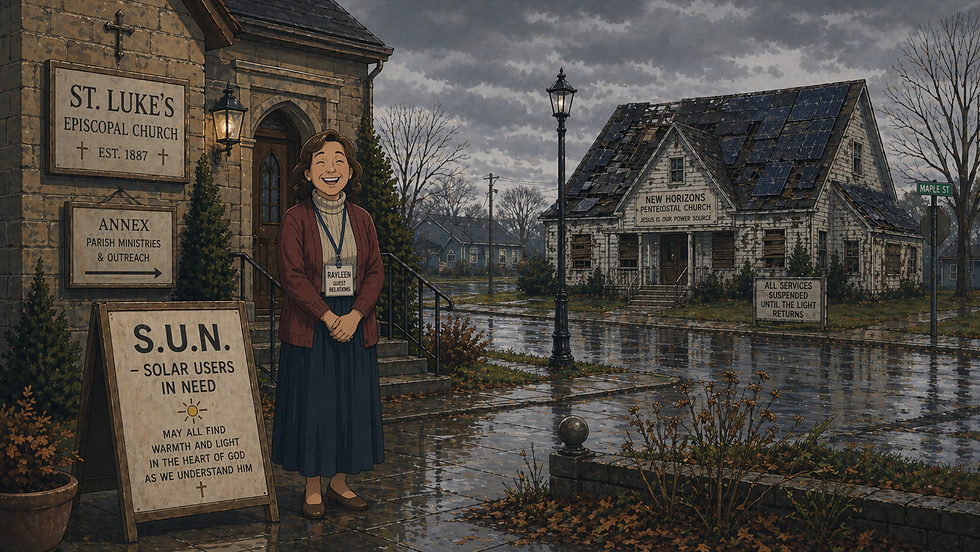
S.U.N. - SOLAR USERS IN NEED
Beneath it, in softer lettering:
MAY ALL FIND WARMTH AND LIGHT IN THE HEART OF GOD AS WE UNDERSTAND HIM
Rayleen wore a lanyard marked “guest relations”, soft shoes, and the expression of a woman who had once sold optimism and now administered its aftercare.
"Welcome," she said. "You are here because solar trauma is real, and naming it is the first ray of recovery."
The acronym did what all modern acronyms do: lined the top of the pamphlets. SUN, it turned out, had sent legal emissaries into every city with enough victims of ‘solar fraud’ to constitute a market. The support packet included a brochure called Fifteen Rays of Recovery. Rayleen walked them through the early steps with the patient confidence of a woman who knew everybody in the room had already lost.
Step One - Understand. Realize you are a debtor.
Step Two - Wrestle. Come to understand you may never repay it.
Step Three - Minimums. Select the smallest repayment plan with the highest available interest.
Step Four - Negotiate. Continually call for discounts. This is your date-night money now.
Step Five - Taxes. Receive your UBI bonus for paying minimums on time.
Step Six - Support. Visit SUN whenever you need help.
There were other steps, but Rayleen skipped ahead with bureaucratic mercy.
Step Fifteen - Highest debt score at death wins.
The ultimate goal was some sort of enlightenment in which you convinced yourself you were better off and then recruited other people to come to the program.
The program, it appeared, overall, was profoundly pro-debt, even turning it into a gamification of sorts. I suppose that once you’ve entered the death throws of debtors reality, you can ultimately just stop ignoring most of the calls.

Fred sat in a metal chair while the others confessed different flavors of photovoltaic ruin. One man had financed church batteries and lost three deacons, a refrigeration vendor, and most of his faith. Another had attacked his own panels with a baseball bat in the sincere hope that insurance would call it vandalism. A third believed the sun had not dimmed at all, merely unionized.
When it came Fred's turn, he said, "I bought a roof and somehow ended up paying more for the same amount of luxury."
Rayleen wrote that down as if it was important or profound.
Fred ultimately left with a pamphlet, a plastic enamel RAY pin, and a ten-dollar Survival+ gift card. The elegance of the gift card was that it guaranteed he would spend more money than what was on it. Even consolation had learned to harvest margin.
For the first time since the panels stopped working, his suffering felt administratively legible.
Having left the rooms, Fred sees in the distance Survival+ and realizes he can stop there for lunch. After a series of mergers, Survival+ stood as a testament for everything outdoors, camping, and apocalyptic planning.
The slogan over the entrance read:
WHEN YOU'RE ABOUT TO DIE, WE HAVE WHAT YOU NEED
Inside, the place felt less like a hardware store than a Pro Shop designed by hospice administrators. The lighting was warm. The music was soft. The food court smelled faintly of fryer oil and powdered eggs. Everything in sight came at a substantial mark-up.
A clerk at the front smiled and said, "Welcome, glad you're alive," in exactly the tone once reserved for luxury retail. Every shelf offered a more expensive version of adaptation. There were full-body compressed towels called micro-towels, shrunk to wallet size and sold beside a note reminding customers that expansion required water. There were buckets of Patriot Pantry Family Reserve, each promising ninety days of beige persistence once properly rehydrated. Water purification systems politely advised against the use of tainted or poisoned water, as though untainted water had survived the pricing meeting. Nearby sat gallon-sized-boxed alcohol labeled Mommy’s Juice, decorative emergency rags bundled beside bottle-necks like a secret message, countertop fungal and herbal starter kits, and tiny portable solar scraps marketed as symbolic independence.
Near the register sat silver canisters branded Kanye's Dentist, each one stamped in huge reassuring letters:
WILL NOT GET YOU HIGH
The containers were marketed with such concentrated enthusiasm that Fred could only conclude getting high had been the internal mission statement, and that the high part on the canister was both a compelling marketing strategy and the products main selling point.
Farther down the aisle, butane cylinders repeated the message in a second dialect:
NOT WHIP-ITS.
There were guns everywhere. Lots and lots of guns. At the counter a background check was in progress. "You wanna kill people?" the clerk asked.
"Just the enemy, sir."
"All right, well listen, you don't drink, do you?"
"Every now and then."
"Well, it wouldn’t matter anyway, everyone needs a drink from time to time. Are you addicted to marijuana?"
"Never, sir. That's the devil's lettuce."
"Okay good, because you cannot be addicted to marijuana and own a gun."
Fred had gone in hoping to figure out how to keep something edible alive indoors. He came out of aisle seven talking to Monty Criss instead. Monty appeared physically, as he should have, because calls are for men with less confidence.
"FREEEEDD," he called from beneath a hanging sign advertising thermal soup. "Have I got a lottery ticket for you. How are the clouds today?"
"Dark as ever," Fred said. "What's new?"
Monty's smile widened with the professional tenderness of a parasite who still
believed in excellent service. He explained that he had joined a class action. The firm was called Trustus Legal Partners, which was either funny or hostile depending on the angle. He had first heard about the class action at 4 in the morning while watching public access cable.
Their brochure promised aggregate recovery for shared harm, a phrase so polished it almost disguised the old carnival underneath. Monty referred to the broader effort, more honestly than the brochure did, as a mass culling of debt.
He explained that the class action already existed, and Fred could join the defendants that had been named in waves: installers, finance banks, regional energy exchanges, climate agencies, shell corporations, maintenance trusts, warranty carriers, datacenter operators, and enough adjacent institutions to make the whole thing feel apocalyptic.
"Under the doctrine of shared reliance and catastrophic misrepresentation," Monty said, tapping the page with a manicured finger, "you may qualify as a plaintiff in the matter of privately financed utility failure under unforeseeable atmospheric degradation."
Fred stared at him.
"In English," Monty said, "some powerful people sold you a lie.”
That part Fred understood.
There were other clauses. A referral incentive if he brought in neighbors. A paragraph reserving first claim on certain procedural assets to counsel of record. A line stating that any housing or land acquired during procedural resolution might pass first through attorney administration. Fred did not fully read it because hope makes men skim.
"You have standing," Monty told him.
Which was not the same thing as saying he had a future, or more importantly would wind up with the house he lost at the end of all of this. Still, Monty spoke softly enough to make despair sound like opportunity. Fred mistook intake for importance the way hungry men mistake menus for food. Within minutes he had built a whole alternate life in his head. He saw a settlement large enough to hide from Cheryl. A different house. Better heat. Neighbors worth despising. He even saw himself pretending not to enjoy having been right.
He signed.
Fred’s deposition later took place in Trailer 14-F, a converted administrative annex that had become more rust than salvageable metal. Rust had taken a liking to the frame and now called it home. The camera was analog because, as the intern explained, "all my digital gear is having some issues lately."
The intern wore a Survival+ hoodie beneath a badge that said Field Intake Specialist in lettering too cheerful for law. A dead microphone leaned toward Fred. Beside it sat a thumbprint pad, a stack of affidavits, and a checklist that seemed to regard suffering as a compliance exercise.
One box read:
MARK HERE TO CERTIFY YOU ARE TELLING THE TRUTH
Another read:
I AM NOT A ROBOT
A third, farther down, asked him to initial beside the sentence:
INITIAL HERE IF YOU HAVE LOST ALL HOPE AND UNDERSTAND THAT EXPEDITED JUSTICE MAY REQUIRE ADDITIONAL FEES
This was the one scene where Fred stopped sounding like the butt of his own life. He looked at the microphone. The camera. The forms. The rust in the corners. Then he told the truth.
Broken home. Broken man. Broken finances. Homeless in slow motion.
He talked about the roof, the debt, the absurdity of making a man finance the death of the very thing he had bought for survival, or at the least, the promise of one. He talked about the guilt, and about how some part of that was his fault and the rest of it had still arrived with invoices. He gave the losses numbers because numbers were the only language institutions admitted to hearing. He tallied the damage as if exact arithmetic might finally embarrass the system into paying its fair share.
At one point the intern asked whether he sought apology, removal of the panels, emotional restitution, or procedural relief.
Fred shook his head.
"The panels can stay where they are," he shared. "I'm past caring. I just want my house back."
The intern checked a box.
Then another.
"Processing will take years," he realized.
He turned one final page and added, with the weary brightness of the trained, "Unless you choose priority review. Faster always costs more, but this time it's worth it."
Fred laughed once, which was the sound a tired man makes when he realizes sarcasm has become a government service.
Years passed in notices and court proceedings.
Fred moved into managed housing designed to look temporary and function permanently. The complex used what the state called the East-West Transitional Grid, a naming system meant to preserve the emotional outline of ownership while removing the substance. His mailing address became a hymn to coordinates: E-17 / W-04 / Street 9 / House 12. Everybody just called it East-West because the full version sounded like punishment trying to masquerade as elegance.
A tablet arrived to help him see the world. Virtual reality cost extra. As if seeing pictures on a screen inside a tin can even compare to the wonder of creation.
Nutrient deliveries came in soft-state language. Each carton described itself as a Civic Sustenance Unit and recommended gratitude as a digestive aid. A heavily advertised fortified beverage called fizzy drink promised calm, liver-friendly optimism, and enough citizens drank it to suggest they believed one of those words.
The case updates said everything was active and nothing was happening.
STATUS: ACTIVE. LIABILITY REVIEW CONTINUES. PLEASE PRESERVE ALL DOCUMENTS, FEELINGS, AND EXPECTATIONS.
The notice changed fonts twice over six years and improved nothing.
Elon, one of the most popular names for reptiles in Fred's day, survived all of it. He stood in the glow of upgraded heat lamps like a minor green prophet who had seen every room Fred had lost and forgiven none of them. When Fred finally bought him a larger enclosure, it felt less like pet care than tribute paid to the one witness who had never lied.
The bills kept coming through all of it. Then one day an envelope arrived thick enough to suggest ceremony. The ruling was beautifully useless. The header alone had enough syllables to sound constitutional:
DEPARTMENT OF WESTERN CONTINENTAL AFFAIRS
Office of Distributed Utility Failure and Civil Recovery
The finding distributed blame across datacenter unreadiness, historical funding collapse, deferred maintenance in public climate-management systems, private financing opacity, weather conditions, administrative lag, and the basic impossibility of assigning sole liability to a civilization that had privatized utility and then acted offended when the private sector offered no guarantee.
The sun, the ruling added, remained beyond jurisdiction.
Outside the building a clerk with a sympathetic face told the waiting crowd, "We're all in the dark here, folks," as though mutual confusion were a public benefit.
Fred received compensation in the way large systems like to compensate: symbolically, ceremonially, insultingly.
The check covered a market-adjusted relocation value calculated after demolition, minus counsel fees, filing fees, review fees, corridor development offsets, and whatever else civilization had found ways to bill by then. Attached to it was a packet of reassurances and, for reasons no one explained, a small custom flag recognizing his civic contribution to Interstate Expansion Corridor 8.
By then the houses were already far gone. They had been bulldozed to build the highway before the verdict arrived. He technically won, but that was the punchline.
For a month and a half, perhaps less, Fred possessed the kind of money that can change a life only if the life in question has already been made very small. He bought Elon a better enclosure. He moved into a unit with fewer drafts. He stood in the kitchen holding the check stub and understood with unusual clarity that his entire existence had been assigned a payout figure and then discounted for administrative convenience.
Then the money became rent, heat, food, back payments, and memory.
By the time the ruling came through, the houses had been flattened to build something more efficient. Eminent domain had done what all large systems do when patience runs out: it reclassified memory as space.
Fred won on paper.
And the ever-present sun, or I suppose, more importantly nature itself, was never the villain in any of this. The villain was the old human craving to turn necessity into product, product into debt, and debt into a moral test for the people trapped beneath it.
Never trust a revolution that offers financing.
Did You Enjoy this Satire?
Consider checking out Patreon for more



Comments