

Life and Depth

Updated: Apr 22
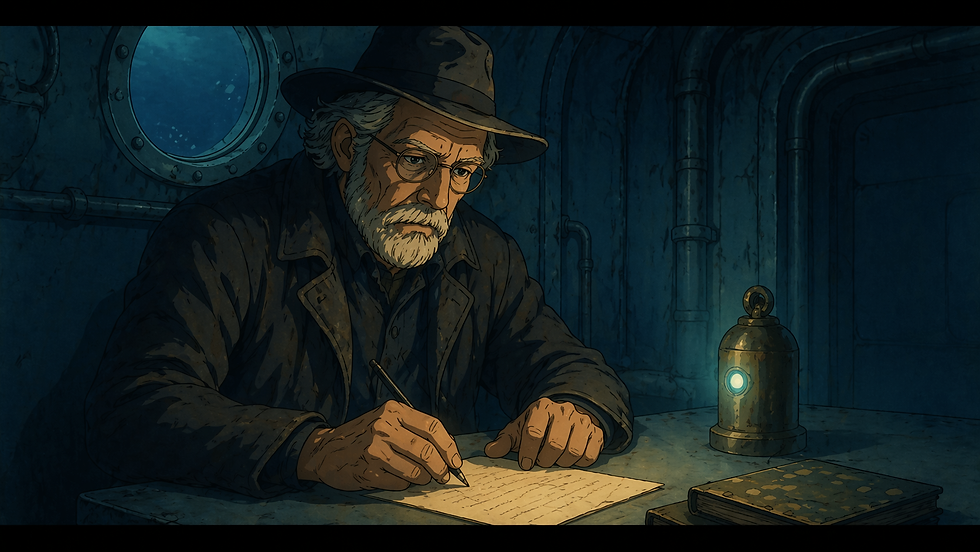
Thomas Seine is a biotic-archaeologist, deep-sea diver, and reclusive essayist known for vanishing into forgotten places and returning with impossible stories carved in barnacle-covered notebooks. Once a celebrated scientific mind in the field of submerged civilizations and neural reef theory, he abandoned academia after a near-fatal descent into an undocumented trench off the coast of Patagonia—an event he rarely speaks of, except in metaphor.
With prematurely silver hair and eyes that seem always lit by some distant phosphorescence, Seine's movements mimic a man burdened by memory, yet guided by compulsion. He writes in half-rhythmic stanzas, often by hand, refusing digital tools unless required for communication with institutional sponsors. His voice, when he does make the effort to speak, is slow and deliberate, as though each word is surfacing from a pressurized depth.
Barbara Seine
For when the tide returns.
If this reaches you, it will have meant that some part of me endured - that the seal held, that the tether hummed long enough, that this ship, The Atlas, was not entirely swallowed.
I am writing to you from 2,100 meters above the Milwaukee Depth, during final descent. It is dark here - darker than it should be - and the oceanic-revealing light we generate dims faster than expected, so fast that it's almost a waste of electricity. My nerves and thus my hands are steady, for now. The narcolepsy has behaved itself so far. On a mission staffed by wartime arithmetic, that counts as plentiful grace.
Please share this letter with our son, Matthias, when he is old enough to understand why I went. I know what the world says of this expedition. That it's mad. That it's myth-chasing. That neural fossils and biotic code are science fiction, not sediment. But you, and perhaps only you, have heard the way the ocean speaks to me. Well, that, and my national duty.
To my parents - Mother, Father - I never found the shore you asked me to return to. I followed the maps, I traced the veins, but the compass always spun toward depth. Forgive me. I was not built for fields and fences.
Matthias, my boy... when you read this - and you will read this, I pray - know that you are my pride and joy, moreso than any of my other research and accomplishments. You are more real to me than the pages I've written and more lasting than anything I've pulled from coral crypts. Your dreams are the bones of something sacred. Follow them.
I joined this voyage, Barbara, because some men are drawn to mountains. I am not one of them. My curiosity has always pointed downward - toward weight, toward silence, toward the slow-turning truth beneath sediment and salt. As part of my life's mission, this was not simply another task. It was the task. A descent not just into depth, but mystery.
This expedition is the first key, the first real answer that I can discover.
I want to be remembered. I admit it. Maybe it's ego, but I just want to accomplish something great. That’s why I am writing you now. And words do not die as easily as men. Especially men in a metal coffin quickly approaching an unknown seabed.
You know what the bills look like. Without me taking this job, we wouldn't even be able to afford to eat. The government is the only one paying these days, and only in the military was I able to find work. The war did not ask for the best man, only for one who could dive, read ruins, and keep speaking when the lights went out. And in that miserable arithmetic I was enough.
Mother and Father – oh, how I miss you. Odd, isn't it? That the physical form can fail but memory remains. They don't remember who I am, but they know the rhythm of my voice.
Their care costs more than I could ever earn above the surface. The grant for this mission covered it all. Full-time assistance. Medical equipment. Home security. I even paid off your car, finally. I wanted you safe. I need you safe.
So yes, I am a diver. An academic. A dreamer.
But I am also a man trying to keep his family from drowning. I sank so you wouldn't have to.
If anything happens down here, know that I didn't do it for glory. I did it because I believe in truth. I did it because I love you. Because Matthias deserves to grow up without fear. Because the only thing heavier than pressure is regret.
One last thing, before I sign off - for your smile, if not for the record.
This morning, our maiden voyage, I overslept by an hour. One full hour.
Woke up to an empty bunkhouse, my head pounding like sonar. Scrambled to dress, tripped over a chair, realized halfway down the path to the dock I only had one shoe on.
You can imagine the scene - me sprinting down the boardwalk, hungover, half-laced, cursing the gods, with my shirt buttoned diagonally, while the crew observed while roaring in laughter.
They said I'd passed the final test. That I was "one of them now." That I'd earned my place in the circle of idiots and dreamers. But more importantly - they swore, swore, I'd never have to drink with them again.
"We need at least one sober man on this tin can," the captain said. "Might as well be the one who uses words like 'tectonic plates.'"
May you always rise. I love you.
Yours beneath every tide,
Thomas

Thomas folded the letter slowly, fingers lingering on the paper as if it could still hold warmth. He slid it into the sealed pouch reserved for personal effects and emergency testimony, the kind of compartment built by engineers who had learned to respect grief as an organizational category.
On the small metal desk beside him, humming with latent charge, rested a peculiar device: a polished steel cylinder ending in a ringed grip and optic diode: the morse-code generator.
His job, after all, wasn't just to dive. It was to speak. Data transmission at these depths was difficult. Long-range radio buckled under the water column, and rich signal died into static long before it reached the surface. Thomas's answer was older and stranger-looking than the rest of the Atlas: a narrow blue-green optical burst unit, tuned for seawater, meant to carve short coded flashes upward toward a passive reflective receiver buoy and, from there, to a surface relay. It could not send a city. It could not send proof in full. It could not send anything broad enough to save a reputation. It could only send the kind of message a dying expedition entrusted to light.
He thumbed the calibration ring and watched the diode harden into a pin of cold color.
A language of light. Dots and dashes on the ocean's invisible skin.
For a harmless test phrase, the sort of thing nobody at the surface would misread as panic or prophecy, he had settled on two words.
Still here.
The corridor outside his berth carried the ship's one concession to morale. A band of holo-paint ran almost the full length of the passage, organic LED pigment breathing through the metal in warm cinematic pulses. Someone at the ministry still insisted on calling the expedition Project Atlantis, because surface people preferred their mysteries compared to existing myths and legends. Lady Liberty stood in one panel over a painted trench. In the next, the Atlas descended through luminous blue spirals toward a city sketched in gold lines and impossible hope. Then the loop reset and the sub rose again under a banner that read: RETURN WITH TRUTH.

Thomas had begun to resent that part.
He moved past this glorious piece of propoganda and into the common room, drawn by the smell of overworked bread and cheap coffee. The war had not provided the proper crew, but instead had provided the available one, which in wartime was close enough to a qualify for comfort.
Jack stood at the stove in an apron that looked sarcastic on him. Francis held both hands tight around an earthenware mug, with the expression of a man who could detect theological error in the browning of toast and the rising of sourdough. Tyler Burden sat in the back corner wearing the captain's hat as if he had been born into maritime delusion. Kyle was at the far table sketching the window view from memory, though memory kept changing every hundred meters. Trent Razor, the only man aboard who seemed offended by rest, was already halfway inside an open panel, one wrist disappearing into light.
Francis raised his hand slowly, then lowered it again. "I would challenge you, Jack. But I fear your religion is bread-based, and I lack the proper credentials."
Tyler Burden, seated near the back corner, quiet until now, reached across the table and poured himself a double from the bottle marked Cooking Vodka (STAFF USE ONLY).
"I object," he said, pausing for dramatic effect, "to eating all of that bread before supper.”
Thomas chuckled despite himself. "I came in for food," he muttered, "but I suppose I'll just feast on your logic instead."
Trent looked up. "Highly indigestible."
The laughter rolled over them in a single wave - quick, genuine, then gone.
And for a moment, the Atlas didn't feel like a coffin.

Just a very strange kitchen, very far from home.
The mood held long enough for Jack to slap two slices of blackening bread onto a tray and declare them adequate by military standard. Then the ship shifted in its harness, and Thomas turned instinctively toward the window.

He stood at the rim of the circular pane in the common room, steam from his tin mug clouding the glass. He wiped it away absently with his sleeve and leaned forward, the familiar ache of pressure setting behind his temples.
Outside, the world moved like a dream held underwater. The Atlas descended fast - faster than they'd planned, faster than they'd admitted. But what caught Thomas' breath wasn't the speed. It was the view.
Mountains. Dark ridges in the distance, towering and sheer, passed them by like silent sentinels. Impossible shapes - formed not by volcanic churn but by some deeper folding of the Earth - glided upward as the submarine dropped. Each one vanished into the murk as if swallowed by the sea's own memory. No light reached here. Not naturally. And yet... they could see.
The glass glowed faintly with the light of their own descent, haloed in the humming wash of soft floodlights mounted around the hull. That faint shimmer caught in plankton drifts and fish scales, igniting life in liquid form.
Ocean creatures - real ones - darted into view. A school of Paranthias colonus, their translucent fins shimmering like woven glass, scattered and reformed in spirals. A massive, solitary grouper coasted past with glacial ease, eyeing the sub as though it recognized it. Farther off, a pod of deepwater false killer whales arched gracefully through a forest of drifting jellyfish, the weightless ballet disrupted only by the metal sphere slipping past like a foreign moon.
A flash of vertical stripes: Chaetodon striatus, banded butterflyfish - impossibly deep for their usual range.
"Deeper even still," Thomas muttered to no one. He should have been concerned. Instead, he whispered their names aloud like sacred liturgy, matching species to shadow:
"Thunnus obesus... Rhincodon typus... Apolemichthys arcuatus..."
It was better than any aquarium. Better than any childhood museum video loop
It was Eden. It was death. It was the past before past.
The kind of moment that only existed at depth. The kind where the soul forgets what century it belongs to. And yet - as Thomas looked further, beyond the brightness and life - he saw something else. The fish thinned. The shadows lengthened. Something down there moved that wasn't a fish. Or maybe it didn't move at all. Maybe it simply waited.
Nothing drifted at random anymore; even the living things seemed to obey corridors he could not yet see. The lights flickered. Just once. A hiccup in the submarine's breath.
Thomas found himself following that shiver into the engine room as if the vessel had called him by title. The engine room wasn't an engine room in the old sense - no churning pistons or coal-fed chambers. It was something else entirely. A a womb of alloy, humming the rhythmic pulse of modernity.

The moment the door hissed open, the air changed. It was cooler, drier. Smelled faintly of ozone, copper, and the whisper of burnt lubricant. The room stretched in a half-circle arc around a central core: a black column, slick and reflective like oil caught mid-thought. Up close it was less mystical than it wanted to look - the pressure-management spine, ballast logic, the functional heart of descent and return. It pulsed - gently, not unlike a sleeping heart.
Tubes and fiber-threaded conduits ran like vines across the ceiling and down the walls, breathing in unison with invisible pumps. Each wall panel was affixed with holo-dials that showed real-time pressure conversion, magnetic calibration, sonar drift, and dozens of fields Thomas didn't even pretend to understand.
To the right was the hydrothermal regulator, a coil-ribbed sphere cradled in shock-resistant foam. At its base, plasma-like fluid rotated through transparent channels with a glow like bioluminescent blood. Beside it, a control array flickered quietly, self-correcting with twitchy, insect-like precision.

To the left: Drone Command. A rack of neatly docked scout units - sleek trilobite-shaped machines the size of torpedo shells - each one magnetically locked into a recharging groove.
Atlas got down the old-fashioned futuristic way: ballast collars, trim tanks, controlled compression, and just enough attitude correction to stop a bad descent from becoming a coffin tip. It was not built to dart or dance. It was built to survive pressure, hold a crew together, and come back up if the sea allowed it. Trent trusted the equations more than the men riding inside them. Thomas trusted neither entirely, which was one reason he kept looking at the Morse unit.

Trent closed a panel with the heel of his hand and glanced over.
"We go down by managing weight," he said. "We come up by dropping it. After that, physics remembers we're lighter than the dark, and we make it home."
The lights flickered again. Just once. A softer hiccup this time. And then - stillness again. Thomas meant to lean against the bulkhead only for a second. Unfortunately, he had forgotten his narcolepsy medication. That fact arrived just before sleep did and proved, yet again, the lesser of the two.
He woke to silence. He blinked hard, disoriented, the familiar pulse of the black column behind him humming like a lullaby that had overstayed its welcome. The engine room lights were dimmed, pulsing in intervals - arrival mode. His neck ached from where it had leaned against the bulkhead. How long had he been asleep?
He didn't need to ask. He knew the truth the moment he saw everyone already gathered. By the time he reached the launch console, the room had tightened into one shared breath. One by one, the drones dropped from their magnetic clamps and scurried through the launch tubes like metallic insects.
Outside, the view twisted through the kaleidoscope lens of the pressure-resistant window. Sand drifted in long, impossibly slow curls. Then -
Structures.
Kyle was the first to speak. "That's... that's a city."
The feeds confirmed it. Buildings. Streets. Collapsed towers and bent scaffolds swallowed by coral and salt. But not stone. Not ruins of timeworn antiquity.
Metal. Plastic. Glass screens long defunct.
"Yes," Trent muttered, almost to himself. "Monitors. Multiple generations of tech."
Wires snaked like ivy inside collapsed walls. Antennas protruded from crushed rooftops. Neon tubes blinked weakly beneath a haze of drifting sediment. The drones pushed forward, crawling over shattered roads littered with blinking tech, fused circuits, melted steel.
Then the first drone paused. Its feed juddered. A burst of snow ran across the monitor and cleared. When it came limping back toward the tube, one side of its shell wore three parallel scores - too clean to be coral, too exact to be chance.
No one said anything. The second drone kept going. One turned a corner - and froze. The camera feed panned upward slowly. A bar sign hung crooked above a rusted awning, barely attached to its mount by two screws and a coil of blackened wire. The lettering, mostly intact, read:

THE SILVER ANCHOR
Coldest Dive This Side of the Universe!
Beyond it, flood-cut channels ran between the skeletons of high-rises. Their upper floors still held the grammar of offices and apartments, all of it drowned under silt and a patience older than law. This wasn't a myth built backward from longing. This was infrastructure. An engineered place. A city dragged under with its signage, its wires, its appetite for light, and its habits of life still visible in the bones.
"These aren't relics," Thomas said, and no one corrected him.
Some questions weigh more than pressure, and the room seemed suddenly full of them. Kyle leaned in so close to the monitor his breath fogged the screen. "If this gets buried again, that's on us." Francis turned his face from the glass as though the city had insulted him personally. "Or it stays clean for one more generation instead of being skinned alive by committees."
Jack rubbed a thumb against his lip. "Anything with this much metal under it gets claimed before it gets understood."
Trent didn't look away from the scored drone shell. "There's more than just machines down there. There's power. Algorithms running on hardware we don't even recognize. You broadcast that to the surface and it becomes weaponized before we even learn anything about the discovery.”
Captain Burden, voice level, asked the question as if he were placing a blade on the table.
"Do we stay quiet and protect what we found? Or do we risk exposure - for the chance that maybe, maybe, the surface is ready?"
Thomas kept one hand on the Morse generator. He could feel the polished barrel warming under his palm.
"I can send a burst," he said. "A coordinate. A warning. A phrase short enough to fit inside somebody else's certainty. I cannot send a city. I cannot send context. I cannot send proof heavy enough to keep men honest."
He took a breath. Slow. Heavy.
"I say we tell reveal everything.”
Heads turned.
"If what we found down here is real - and we all know it is - then this is the greatest archaeological and technological discovery since... since history began. The world doesn't need another myth buried in silt. It needs truth."
He looked from face to face, letting the fear stay in the room where it belonged.
"Yes, it could be misused. All knowledge can. Fire cooks food. Fire burns cities."
"And yes, it'll be politicized. It'll be twisted. But silence... silence is complicity. We've seen too much to disappear into the dark."
Kyle nodded first, too quickly. Francis did not nod at all, which in Francis counted as restraint. Jack swore softly under his breath. Trent held the drone shell like it had insulted his profession.
Thomas straightened and gave them the only line he knew would stick.
"History has eyes, gentlemen. And it will remember who looked back."
Burden closed his eyes once, opened them again, and made the captain's version of peace with everyone else's bad idea. "Bring them in," he said.
They recovered the drones. The scored one slid into its magnetic groove with a sound like a knife being sheathed. Outside the glass, the city went on saying nothing.
The first ballast release boomed through the hull like a distant door being shut.
The Atlas began to rise.
For eighty-three seconds, nothing happened.
Then a repeating smear of static crossed the starboard monitor in intervals so regular they looked polite. The same beat came again. And again. Not noise. Not failure. An address.
Before Thomas could say it, Kyle was already at the glass.
"There," he whispered.

Outside the diamond viewport, something moved. It wasn't a shadow. It wasn't a current.
It was a shape. A massive form, circling slowly around the sub - squid-bodied, vast as a blue whale. Its tentacles shimmered like sharpened stingray wings, gliding through the water with effortless grace. Atop its body was a dome of translucent jelly - bioluminescent pulses racing along veins of some internal light. But what froze the crew wasn't its size.
It was the eyes. Set like a baleen whale's - lateral, intelligent, ancient - and something else: wires. Running from eye to core, blinking with soft orange fire. The creature's base - its long, flowing underside - was riddled with ridged plating. Like armor. Like tech.
Trent whispered, "That's not alive." But it was. It moved. And then - it struck.
The first impact came sideways. The Atlas lurched hard enough to throw Jack into Kyle and Kyle into the console. Warning lights erupted across the compartment, red and furious. One of the monitors blew white, then black. Another filled with a close pass of plated skin and moving light. Thomas slammed shoulder-first into the bulkhead and staggered back to the window in time to see the thing circle once more. Where one of its limbs had scraped along the hull, there were sparks - not blood. A cable hung free, split like a torn tendon, leaking pulses of light instead of fluid.
It wasn't a creature. It was a construct. A relic. A remnant. The second strike hit low, under the line of the ballast housings. This time the sub groaned in a long animal note that made every man aboard sound suddenly irrelevant.
The thing did not move like a predator. It moved with the brisk indifference of municipal cleanup, as if the Atlas had already been reclassified as debris.
Pressure collapsed like a judgment. Bulkheads folded. Glass spiderwebbed. Oxygen vanished in a blink. Somewhere behind Thomas, Burden shouted a command that pressure took apart before it reached anybody whole. The room cinched inward. A seam peeled. Water entered like a sentence finally enforced.
Thomas dove for the transmitter - the Morse generator - and spun it toward the escape line. His fingers a blur, he clicked the final message:
As above. So below.
Then everything caved. The Atlas imploded inward in a single, mournful silence. The creature - calm, patient - wrapped its limbs around the remains and, in a motion both graceful and surgical, consumed the sub. It folded open like a mechanical maw, its undercarriage revealing steel-tined plates, and swept the wreckage inside.
Like a garbage truck. Like it had done this before. Like it was meant to.
As the final light vanished into that beast of circuitry and cartilage, I’d love to tell you they lived.
And, truly, I wish I could. But with the way the sub folded before being consumed by the creature, pressure strong and wild like the wrath of God, I find it very unlikely. The sea keeps stranger ledgers than certainty, so I will leave one inch of doubt for mercy and no more. Thomas sent the last message to the surface. Whether it was received, or believed, I do not know.
But somewhere, drifting between sea and silence, is the truth of it.
A city forgotten.
A creature built.
And a crew who descended...
for life and depth.


Comments