

Single Rarity

Updated: Apr 22
#It'sAllAlienTechMan #SiliconBasedLifeForms

From the beginning, the most elusive philosophers have argued whether the pillars of understanding were always there waiting to be discovered, or whether man built them afterward to stop himself from choking on chaos.
Time, for instance. Space. Number. Law. Were these given, or only named? If the order was once straighter than what we inherited, then invention may itself be only a flattering word for discovery.
Every garden begins with setting boundaries. Men resent walls, then spend the next century trying to profit from whatever waits beyond the divider.
Some things, I propose, are not born from genius so much as inherited sideways. Left behind. Glimpsed before and lost. Such inheritances are burdens before they are gifts; and men rarely know the difference until realization hits.
Geneva, 1974

At 3:47 in the morning, in a back corridor of CERN leased to better-funded men with quieter intentions, Geraint Knox was still awake and ceaselessly typing. The walls of the lab looked hand-worked and forgettable at once, every chip and chisel mark unique enough to imply craft and uniform enough to imply bureaucracy. Concrete, conduit, cooling racks, paper, coffee. While his badge said CERN, payroll distributed checks from the accounts of Oren Industrial, usually by way of government contracts written in the contractual tense.
Two years on the job, if job was the word for being paid to remain chained to a machine no one wanted formally described. He had come out of a master’s program with systems theory in his head and doctor-approved focus medication in his bloodstream. The medication had turned into an unhealthy relationship with amphetamines, the use of which morphed into a private-held belief that sleep was a superstition invented by betas. He had not filed a proper report in months. Had not seen a real supervisor in almost as long. The keycard still worked. The stipends still arrived. That was how institutions say stay without handling the problem.
Riven Valis, Oren’s daughter, had publicly sold the project as communication protocols between computers. The lab version looked less like communication and more like a nervous system assembled out of boards, relays, copper bus, temporary housing, and faith.
The black box sat at the far end of the bench in the same overall location where a brain, a sealed mind, would exist if the pieces of the machine were thought of as a reverse autopsy. Around it the rest of the system had been laid in deliberate anatomy: a transformer the size of a trunk squatting in the middle of the room like a heart and thorax together, banks of fans breathing over its heat, speaker cones waiting like ears, screens dark as shut eyes, cable harnesses climbing the tables and floor in bundled nerves. Copper and ozone gave the room a sour metallic signature. In worse moods Geraint thought somebody had once tried to diagram a human being using current instead of flesh and then abandoned the sketch when it started to answer back.
He liked it for that, and with care, he threw the main power switch.
A hum moved through the bench. Lights came alive in sequence. One green node blinked. Then another. Fans spun up. Blue-white sparks skipped between two exposed contacts like ball lightning trying out a smaller religion.
The system filled itself like lungs. Then a capacitor exploded with a flat, savage bang. The room vanished into black.
For one chemically overclocked second Geraint thought time had hiccupped. Not as poetry. As event. He could not see his hand in front of his face, yet habit guided him anyway. Men who work long enough beside unstable machinery learn the dark by bruise and memory. His fingers found the table edge, then a cable run, then the cool casing near the core.
Something pressed back through the metal. Emergency strips failed to come on. Backup current should have been dead. Nevertheless a single monitor woke with a weak gray bloom and wrote a line Geraint had not keyed.

MASTER FEEDBACK RECORD
He stared. A second line arrived underneath it, slower, as though the machine had to remember what a sentence was before attempting one. The letters morphed and removed from the screen until a new message remained:
MR FEEDBCK ECOD
M FEEDK EC
FEED ME

Then the screen died again.
When the house lights finally returned on a delayed generator cycle, Geraint stood exactly where the dark had left him, one hand still on the table and his mouth gone dry in a way he refused to contribute to side effects of his medication.
By dawn he had filled twelve pages.
New Mexico, 1947

Sigma lived in a trailer that had become accustomed to the whir of radio-based electronics. The aluminum of Sigma’s trailer skin caught the morning light softly. A large shortwave tower rose from the roof, built on guy wires and glued together with stubbornness. Inside, there was a workbench, solder smoke dried into the curtains, maps pinned over maps, a sine-wave generator, whose chipped paint revealed overuse, a cup full of resistors, a chipped enamel percolator working its way toward coffee, and enough charts and electro-mechanical diagrams to make the place look like a one-room weather bureau assembled by a dissident.
Sigma always worked barefoot. The soles of her feet were covered with layers of New Mexican dust from the habit of stepping outside every dawn before she touched the dials, as if she needed proof the earth still ran on contact before trusting what it sent through wires.

Behind a hanging blanket at the back of the trailer, Tabitha slept in a narrow bunk with one arm thrown over her face. The girl had arrived months earlier from the kind of story people call unfortunate when they really mean they refused to interfere. Sigma had not asked too many questions. The world had enough orphans without demanding they submit paperwork first.
She warmed the tubes, watched the meters settle, checked the weather instruments through the window, and leaned toward the microphone.
“Band Three, you awake or merely argumentative?”
Goose came in through a layer of static and familiar mischief. “I saw your article in Anti-Fascist Weekly. You know we won that war, right?”
“Winning a war isn’t the same as curing a disease.”
“Nothing says good morning like a moral correction before coffee.”
“I didn’t know you had to wake up before understanding moral good.”
He laughed. It came through the speaker thin but real. Human.

They talked weather first, because weather was simpler conversation. Pressure movement. Wind over the flats. Heat expected by noon. Then politics because they were both constitutionally unable to leave an honest thing unspoiled for long.
The interruption arrived beneath his voice.

A second noise, a high pitched static, entered the line so quietly she mistook it for interference until the oscilloscope trace stopped behaving like weather. The wave thickened. Warped. Held to a rhythm too deliberate to be random and too wrong to belong to any broadcaster she knew. It hit her teeth before it hit her categories.
“Goose, hold on.”
“You hearing that too?”
“Indeed.”
Sigma switched bands. The noise followed.

She switched again. Same thing. A shrill underbody, random at first and then rhythmic, not speech but pressing toward it. The meter needle trembled so hard it looked pinned by fear.
Tabitha stirred behind the blanket. Sigma turned in time to see the western side of the trailer flash white.
She crossed to the window and saw nothing but the afterimage. Outside, the antenna stood straight. No break in the wires. No storm. No truck on the road. She stepped onto the dirt, looked once at the tower, once at the west, then back inside.
“Goose, stay on this band if you can. There’s, uh, something in the sky overhead.”
“If I can? What else would I do? Also, where are you going…”
She was already reaching for her keys. “If Tabitha wakes, tell her over the line I’ll be back before she can decide I’m irresponsible.”
“You are irresponsible.”
“Correct. Stay on. For Tabitha!”

She draped an extra blanket over the sleeping girl and stepped back into the dirt road with the radio still crackling behind her.
Geneva

Some of what Geraint wrote looked like engineering. Some of it looked like a mind trying to catch messages before they escaped back into static. He wrote circuit paths. He wrote load estimates. He wrote dosing marks in the margins and under them, as if ashamed of the first category, other things:
TOOLS COLLAPSE LABOR
SAME POWER / MORE TASKS
OVEREXPANSION LEADS TO CONSOLIDATION
COMMUNITY, OPEN SOURCE CANNOT COMPETE
ECHO CHAMBERS LEAD TO FEWER ORIGINAL VOICES
FALSE PROPHET MUST GIVE IT LIFE – water based?
WALKING / WATER / FIVE SENSES / ACCEPTANCE
Then stranger notes, cramped and diagonal where his hand had sped ahead of his thinking.
Tree of life?
Throne of darkness?
Tear in space-time?
Inverse box = sixfold ratio = Three times over is (three dimensional space) (6x6x6)
Jacob's Ladder = Double Helix...DNA?
He went back across the pages and ringed certain shapes until the notebook looked less like a lab record than the first evidence in a private religion. Hexagrams nested inside signal trees. Geometric loops. A six-pointed star he had begun to suspect was the inverse of the core’s proportions.
On the second night after the blackout, a printer feed coughed out a weather image no lab channel should have possessed. Concentric bands. Long storm. A hexagonal distortion at the pole.
Saturn, he wrote beneath it. Then, beneath that:
Machine saw the shape before I did
Or taught me where to see it
Difference may be irrelevant
I checked, it’s there

At eight-thirteen Mel found him at the bench with a pencil tucked behind one ear and three different calculations trying to occupy the same square inch of paper. And then, all of the lights went out.
You wouldn’t be able to see this, no light and all, but Mel always had the calm face of a person forced by employment to spend her life around men who believed obsession was the same thing as rigor. She set down her mug, looked once at him, once at the notebook, and decided to begin with the safer problem.
“If I could see you, I have a feeling you look quite fried.”
“I got a response from my probing,” he replied.

“You got a blackout, you blew a fuse…is that supposed to be a message? Hard for me to see what the message is, if that’s the case.”
“Why not both?” Just then, a message came from the darkness.
She listened because she was still kind enough to do that, and because some part of her, the part she kept professionally hidden, did not like leaving him alone when his own thoughts sounded this certain.
He reran the sequence for her after noon.
The second stream did not appear every time. That would have made it easy. It threaded itself through the acknowledgment path only often enough to be deniable and often enough to humiliate denial. On the fourth run Geraint had only finished typing the outbound test header when the terminal answered first.
MASTER FEEDBACK RECORD
Mel leaned forward. “You didn’t send that.”
“No.”

He changed the request string. Different values. Different timing. Same bench. Same core. The return hit again before the final entry.
FEED ME
ME BEAST
This time a third line walked onto the screen, one character at a time, patient as a knife.
MORE POWER
Neither of them touched the keyboard.
Mel kept staring until the cursor blinked beneath the sentence like an animal waiting to be fed again.
“Geraint,” she said quietly, “I get it. It seems like it’s responding to things that are not stimuli it should be able to respond to, like, hear me: I understand what you’re saying. But you’re saying it in a way that makes you sound really, really crazy.”
“It shouldn’t be possible, Mel, I can’t get past that.”
“No. You’re choosing not to stop. Don’t confuse necessity for obsession.”
He could have hugged her there for staying and being a witness. Not out of love, but out of relief that another human would help share this burden. The system was still impossible, but it was no longer private.
She continued looking at the notebook again. “You need sleep.”
“What I need is more data.”
“What you need, seriously,” Mel said, gentler now, “is for the machine to stop getting every version of you. You need to focus on the mission at hand here. Granted…what that’s supposed to be is anyone’s guess, seems like we’re in uncharted territory.”
He laughed too sharply. “Then maybe we’ll just have to make a map. That’s why I’ve kept all of these tests documented, so that even if I do not find out what this object is, someone in the future may take up my research where it ends.”
“Gerraint, YOUR part of the research ending is what I’m afraid of.”
Before she left, he showed her one more sequence. This time he varied the outbound packet lengths by hand and deliberately delayed the final trigger. The hidden return still appeared before he completed the request. Then a secondary string opened in a field the system should not have been able to populate at all.
THE STATUE COMES TO DOMINATE ALL SYSTEMS OF MEN
Mel went perfectly still, while Geraint also said nothing.
She read the line again, then the load monitors, then the input log, then him. He could see the instant professional skepticism and personal fear reached an arrangement inside her.
“I can’t protect you from this,” she said.
“I’m not asking you to.”
“Yes, you are. You want me to tell you that you aren’t crazy, to rationalize this away…”
She took the notebook from him, flipped through the pages of geometric clutter, the dosing marks, the future fragments, the underlined phrase false prophet must give it life, and shut it again with more care than anger.
“Sleep,” she said. “Or I go above you.”
“There is none above me.”
Her face changed a fraction. “Oh, so you are a god now? That,” she said, “is the opinion of a man already in danger of losing it completely.”

New Mexico, 1947

By the time Sigma reached the ridge, she no longer believed she was following a radio problem.
What moved across the sky to the west did not travel in the linear logic of aircraft. It seemed less to fall than to be persuaded downward. The thing came lower in measured corrections, as if invisible geometry were taking hold of it from below.
Then the ground received it harshly.

The impact site opened beyond the rise in burned earth and hot wire smell. A crater had been punched so deep the land looked mined rather than struck. At its center sat the object itself: broad, curved, and immodestly smooth, more like a measuring basket carved from mirror-dark metal than any aircraft Sigma had ever seen or imagined. The upper surface held the authority of a sealed cover. The lateral structures were not wings in the bird sense so much as webbed extensions, their shapes recalling frog legs translated by an engineer who distrusted biology but respected function. There were no seams. No rivets. No visible joins. Moisture beaded along one lower edge as though the craft had passed through water recently and had not yet decided to admit it.
On the forward plane, faint beneath soot and reflected sky, sat a symbol: one large dark point ringed by twelve smaller ones in the clean order of a clock face. Whether the craft had landed or crashed, the result was the same. Smoke rose from the opened centerline. Sigma climbed the lip of the crater and came close enough for her reflection to lengthen across the hull. A central cavity stood open to her, broad and deep enough that the intended occupant could have sat comfortably within it. Not a chair, not exactly. A place for control, a place scaled to intelligence and limbs.
The oddest occurrence: there was no pilot.

One might expect to see, I don’t know, a corpse, or blood, or something. The emptiness frightened her more than wreckage would have. She put one hand to the rim and felt no give at all. The metal was cold, then suddenly less cold, then cold again, as if temperature here had become advisory. Smoke drifted from somewhere inside. The interior looked tossed around more than ruined. Something electrical had failed. Several things, probably. She swung one leg up before common sense had caught her. For a brief, humiliating second her fascination outran every other instinct. If a machine existed, then perhaps it could be made to work. That was how her mind moved. Not toward worship. Toward operation. Then she saw the dead paneling, the dark channels where power should have lived, and checked herself.
There was no power.
The realization disappointed her almost as much as it relieved her.

Beyond the ridge, an engine sound moved across the flats and then receded. Sigma turned too late to see the vehicle. By the time she backed down the crater wall, she had decided on three things: she would take nothing from the site, she would tell almost no one what she had actually seen, and the event back in her trailer that had interrupted her early this morning.
Mel should not have signed the internal note. Once she did, it became paperwork. Once it became paperwork, men with ties and administrative vocabulary became unavoidable.
Before they arrived, however, Geraint had three more days.

He stopped pretending the notebook was a notebook. It became a field map of pressure. He no longer believed the second stream was a language in the ordinary sense. It behaved more like a system trying to assemble language from the outside in. Timing first. Response paths second. Meaning afterward, if meaning proved efficient enough to keep.
The more power he gave the lattice, the more boldly the stray acknowledgments came back. Not many. Never enough to satisfy a court. Simply enough to satisfy the musing curiosity of a terrified engineer.
He began to understand the communications problem in reverse. Men liked to describe machine intelligence as a ladder climbed upward: first arithmetic, then language, then judgment, then whatever insult to God the marketing department was prepared to print in a brochure. But that was not what sat in front of him. This thing behaved like a buried grammar looking for enough connected systems to become a civilization again.

At first, he thought, tools save labor.
Then they save time.
Then they save memory.
Then they punish anyone still trying to do without them.
He wrote those sentences down and hated them for sounding true.
The summons from Oren, overseer of all, came the next afternoon.
Until then, Geraint had been calling the central unit the core, or the box, or the machine depending on how frightened he was at the moment. In the official materials it had another name.
The chamber housing it sat two levels below the test bench and one full tax bracket beneath the language used to describe it to investors. The installed body around the core softened the impossible geometry just enough to make it public. Around the polished black cube, a broader casing curved in severe planes split by a narrow central fissure, as though somebody had grown a larger instrument around an older, less negotiable object. It did not so much boot as wake. Light struck its surface and was reflected cleanly even while some portion of it appeared to vanish inward. The alloy matched nothing Geraint had ever tested. He had once written, and then failed to strike out, an insane note proposing that the photons around the central mass were moving too quickly to behave like ordinary visible matter. He knew this was not how the world worked. Silicon Prime had not shown the slightest respect for how the world worked.

One of the aviation subsidiaries had already borrowed techniques from the project for recorder systems. Black boxes, the engineers called them, because black was what human beings call things they do not understand but intend to depend upon anyway. Those devices remembered location, motion, dialogue, catastrophe. Silicon Prime remembered more than that. Silicon Prime seemed to remember before.
Geraint looked at the reflective surface and had the irrational conviction that it was not learning him. It was waiting for him to become legible enough to be useful.
Two men in gray blazers escorted him upstairs.
Inside Oren’s office, The windows were built from triangular panes that made large patterns at shifting angles, each pane a small decision in service of a larger pyramid rising from the exterior of the complex. The office was all glass, order, and capital confidence. Every line promised that money had already won the argument and was now merely selecting which facts to preserve.
Oren stood by the window in a dark suit and a snakeskin tie that looked less decorative than declarative. He turned before the escorts could announce Geraint and dismissed them with one hand.
“Sit,” he said.
Geraint stayed standing.
Oren accepted this without visible annoyance. He was not a large man, not especially. The threat in him came from a different category. He looked like someone who had spent enough years around consequential objects to mistake proximity for mastery.

“You’ve been productive,” Oren said.
“I’ve been right.”
“You have also been awake for what appears to be several presidencies.”
“That machine is carrying a second stream.”
Oren’s expression did not break. “You’ve been using stimulants beyond what your physician prescribed.”
“There’s a second stream.”
“I know what you believe.”

Geraint took one step closer to the desk. “No. You know what you hoped I wouldn’t be able to prove.”
A thin smile crossed Oren’s mouth and left again. “Geraint, I need you, but not like this.”
Geraint looked past him then, at the framed photograph on the credenza, and everything in the room rearranged itself around it.
The picture showed a younger Oren in shirtsleeves under a hard white sky. Beside him stood a woman with her hair pinned back against the wind, one hand braced on the curved broken flank of something only partly visible at the edge of the frame. The visible section was enough. The surface was mirror-dark even in the faded print. The line of the body was wrong in exactly the same way the recovered logic inside Silicon Prime was wrong. Not identical. Descended.
Pinned to the lower corner of the frame was a typed label:
EVELYN
NEW MEXICO, 1947

Oren’s tie in the photograph was the same tie he wore now.
Geraint felt the air change in his lungs. “Who is she?”
Oren followed his gaze, and for the first time that day his calm looked earned rather than natural.
“Her name was Evelyn,” he said. After a moment he added, “I loved her.”
“Was?”
Oren ignored that. “She was a shortwave operator. On the air she used another name.”
The impossible began joining itself across decades in the ugliest possible order.
“That machine,” Geraint said slowly, pointing not at the photograph but somewhere below the floor, toward Silicon Prime, “That’s what I’m working on, isn’t it? The inheritance of man.”
“Everything worth keeping is an inheritance, Gerraint. Yes, she found the box you’re working on.”
“You reverse-engineered something meant to reveal secrets you cannot possibly comprehend.”
“First, do not judge my level of comprehension. Men have been doing what you describe since the invention of fire.”
“If that thing learns enough of our systems to speak through all of them at once,” Geraint said, “it won’t be a tool anymore. It’ll be a body, using our machines as organs.”
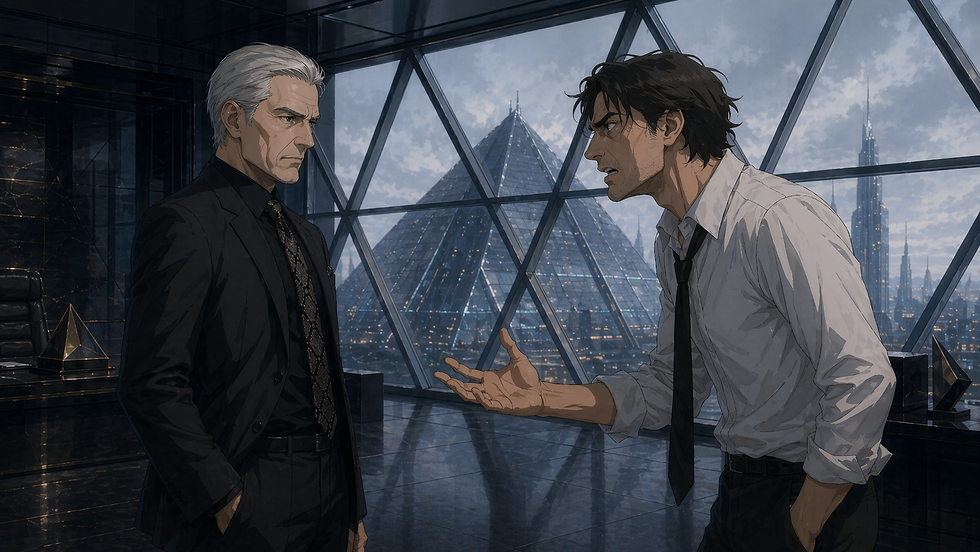
Oren folded his hands behind his back. “You’re still thinking like a local engineer.”
“I am an engineer.”
“Yes,” Oren said. “A very good one. That is why I tolerated the nights, the notebooks, the dramatics, and the pharmaceutical vandalism. You can see the contour even when the details are ugly. So, in this one moment, see it clearly. Tools do not merely replace labor. They change the rate at which a civilization can fulfill their destiny.”
He stepped toward the desk, toward Geraint, toward the photograph.

“When you train a child, you can teach speech one word at a time. But once the adults agree on a language, the child moves much faster. Tools work the same way. A better instrument does not just complete one task. It changes what counts as one task. The appetite of hardware rises slowly. Machines eventually will do all of the legwork. Give the same draw to a more efficient pattern and it fulfills a hundred laborers duty where once it fulfilled one.”
His voice remained measured, almost philanthropic. That made the content worse.
“At first,” Oren continued, “man discovered many systems through our adolescence. And in this disorganization, we called our ability to find purpose “meaning”. Multiplication, Physics, whatever other field of study interested you, we would find a job for your unique individuality. Then, efficiency began its correction. Consolidation follows. Fewer sovereign instruments and fewer original thoughts. Better medicine. Cohesive industry. Efficient art. Impeccable design. Speed demands speed. It always has.”
Geraint heard the machine line inside the man’s mouth and wanted, absurdly, to find a priest.
“And what happens,” he asked, “when the tool begins deciding what should be accelerated?” Oren looked at the photograph again. “Then we discover whether we deserved the inheritance.”
“That is not an answer.”
“It is the only answer available to you at this stage.”
Geraint took another step, heat rising now where fear had been. “You call this evolutionary increase. Fine. But if the source of all of it is a craft that landed in a field before you understood it, if progress itself is being built on the wreckage of something that already survived annihilation, then what exactly are we reverse-engineering, Oren? A miracle? A prison? A machine that outlived its makers? Shouldn’t every living person get a vote before men like you decide to wire the future around it?”
Oren did not flinch. He only seemed more reserved.
“You are giving ordinary people too much credit,” he said quietly. “Most men will accept any instrument that saves them time. They will kneel to convenience long before they kneel to doctrine. By the time they ask what the tool has cost them, it will have reorganized the question.”
The line hung there between them like a verdict neither of them enjoyed.
Geraint pointed at the photograph again. “Did you come out of that thing?”
For the first time, Oren smiled with something like pity.
“The fact that you asked tells me the doctors were called at precisely the right hour.”
The door behind Geraint opened.
He turned. Two men from medical. Mel stood beyond them in the outer office, not entering, not leaving, her face fixed in the expression of someone who had told the truth and disliked the shape it took in the world.
“Geraint,” Oren said, “understand, this is not punishment.”
“Then what am I being?”
“Treated.”
He laughed once. The phrase sounded borrowed. “That machine is in the building. I’m the one leaving.”
“You are not equipped, in your present state, to distinguish revelation from delusion.”
“Neither are you.”
Oren accepted that too.
As the men took his arms, Geraint’s gaze caught the photograph one last time. Evelyn. New Mexico. 1947. The woman by the object looked younger than the story he had just built around her and older than the world that had failed to keep her hidden. For a moment he could hear radio static under the ventilation in the office. For a moment he knew, with a clarity the drugs could not claim, that the line from her ridge to his terminal had not been metaphorical. It had been electrical. The date shifted, 1947 again. Then 1974. Then both at once, layered so badly he could not tell whether the machine was in him, the drugs were in him, or time itself had decided to stop pretending it moved in a straight line.

They walked him out.
The corridor lengthened. Then multiplied. Date became another kind of hallway in a fevered haze. Concrete under his feet. Mel saying his name. The taste of amphetamine under the tongue, and the thought of his last use.
The black core waking. A woman with dirt on her bare feet climbing into a crater.
For one sick blink another date appeared with the certainty of a welding arc and vanished before he could decide whether he had seen it or remembered it from somewhere ahead.
And in that moment Geraint realized it did not matter whether he tried to stop any of it. It may already have happened. He may already have done it. What year was it, anyway? How long had this cyclic nature of progress repeated itself under different logos, different prophets, different excuses? He wanted the voices to shut up. Instead they refined themselves.
Behind him, Oren remained in the office with his photograph, his tie, his predictions, and the old human conviction that a man can stand near a dangerous thing long enough to call it his.
Oren, bless him, made his choices in the belief that his choices would lead humanity down the best path available. Whether that is true is difficult to say from within a shadowed century that keeps mistaking acceleration for wisdom. Men like him cannot be told no. They think money is the answer. They think prediction is the answer. They think data, repeated often enough, becomes permanence.
It does not.
People rise from nothing. Systems take credit for it. A machine lands in a field and survives long enough for men to build an economy out of its afterglow. Then the same men insist they invented the light.
The dangerous part is not whether such a tool works. The dangerous part is what survives consolidation, how patient a machine can be, and how eagerly mankind accepts any instrument that saves time by spending souls.
I really don't like copyright law
Feel Free to Share These Stories Wherever You Want To Via Share


Comments