

Communicate - Copyright - License - Index

Updated: Apr 22
A record label mystery is brought to the forefront of a record store owner's business when an unopened, one-of-one master is stolen.

By 2043, the music business had solved its oldest problem by handing the whole thing to law.
That was the real innovation. Not taste. Not genius. Not discovery. Just ownership, stretched until it could cover every song, every rehearsal, every stem, every archived performance, every rerendered face, every voice that could still be used to move money from one hand to another. The old labels had devoured one another until only larger rights libraries remained, and those too were bought in bulk by whoever had the capital to call acquisition stewardship.
At the center of that arrangement sat The Label.
Simple name. Honest, in its way. It wanted to sound less like a company than like weather. The one gate. The one owner. The one throat through which almost every surviving act of public music had to pass if it hoped to be heard in the open air.

Churches were one of the richest veins due to the mass revival breaking out worldwide. Every church service sang the same songs, and the Label took a cut of every offering by forcing the churches to pay them for use of copyright.
The legal chains tightened slowly enough that most people thanked the machine while it fed on them. The singers who wanted to call gifts from God their own profession learned very quickly that professions came with contracts, and contracts came with rights assignments, and rights assignments always seemed to end with future profits promised to some future enemy. By the time the churches realized what had happened, a direct funnel had already been clipped to their bank accounts. The leeches would have sucked most congregations dry if they could, but the price stayed just low enough that the deacons called it sustainable and the pastors called it a burden worth bearing.
That was how the thing won. Nobody announced theft. They announced convenience.
Human bodies had become the most expensive, least reliable part of live performance. So The Label replaced them with light. Holographic renderings. Simulated worship sets. Whole concert experiences rebroadcast into sanctuaries and civic halls as if presence itself had become a file type. One of the nicer little additions to the package were the so-called ghost runs: complete performances of artists who never had to travel, never had to sweat, never had to age in public, never had to be there at all. Plenty of people said that was kinder. In a world where anyone could, in theory, beam an experience into the air, why make a living body ruin itself on tour?

The machine took its cut before anybody had time to call it ministry.
Physical media still existed, but under a different category of reality. It lived on as inheritance, legal irritation, contraband memory, and collector bait. The Label bought what it could, sued what it couldn’t, and burned what failed to justify shelf space. The rest came back boxed in lucite and sold as Cultural Artifacts, complete with certificates, valuation histories, and enough packaging to suggest sorrow itself could be managed through correct display.
The future did not destroy the past. It put a price on keeping it near your body.

Two blocks outside that future sat Drop the Needle, wedged between an abandoned vape lounge and a time-locked ATM that looked more honest than most banks still pretending deposits meant anything. The window carried three decals at eye level:
NO STREAMING REPAIRS
NO LABEL BUYOUTS
COINs PAY UP FRONT
COINs, in Sonny Revolver’s private taxonomy, meant Collectors In Name Only. Men who wore gloves around shrink-wrap, talked about first pressings like hedge funds, and treated every artifact as a future number instead of a thing that had once lived in somebody’s hands.

Sonny hated them with professional fairness.
On weekday mornings he worked beneath an inspection armature that lowered over the counter like a jeweler’s rig dragged forward from a cleaner century. The lens over his right eye wasn’t really a loupe. It was a little augmented visor that could scan material grade, manufacturer traces, matrix markings, repress history, and rights flags while he held something under the light. Gloves only when an item looked expensive. Never before.
What came through the shop was never just product. It was evidence. Church cleanouts. Estate lots. Attic rescues. Divorce boxes. Dead brothers. Dead fathers. Failed worship leaders. Men trying to turn their last keepsake into rent money before the landlord changed the locks.

That morning it was Mrs. Alvarez from the alterations shop carrying a grocery bag full of devotional CDs her late brother had left in a cedar chest. She set them on the counter with the face of a woman who had already argued with two nephews and a priest before breakfast.
Sonny lifted the top disc, held it beneath the glass, and watched the overlay crawl across its surface.
“Private church run,” he said. “Mid-twenties. Cheap polycarbonate, decent burn, rights chain dead as a stone. Keep it if you want the memory. Sell it if you need lunch. Don’t let anybody tell you it belongs in a museum.”
Mrs. Alvarez smiled despite herself. “You always make me feel less sentimental than when I walked in.”
“Sentiment is expensive,” Sonny said. “If you’re selling off your memories, they should at least leave you enough for groceries.”
She laughed, paid for a full appraisal, and went back to opening hems for richer people.
That was the thing about Drop the Needle. It functioned as a store, yes. It also functioned as the place people brought the loose ends of their dead and asked what could still be held.
At ten-thirty, Johnny Vale wandered in from the block wearing the same black leather jacket he claimed had survived three marriages and one homicide investigation. Greaser by habit, free thinker by self-description, liar by craft only when necessary.
He leaned against the counter and jerked his chin toward a boy carrying a slab case full of collectible cards with the expression of someone transporting a kidney.
“Kid wants investment advice,” Johnny said. “I figured I’d bring him to the least ethical economist I know.”
The boy looked up at Sonny. “What should I buy if I want the most money later?”
Sonny looked at the cards, then at the boy’s hands, then at the groove the case handle had already started to cut into his palm.
“Whatever you choose,” Sonny said, “it better be something you like enough to keep at home. That’s the real test. The good stuff is always too valuable to drag around. Fathers tell themselves this sort of thing will pay for college. With the way money works now, maybe it will. But speculation is still the same old deal. You buy something and pray somebody dumber pays more for it later.”
Johnny barked a laugh. The boy grinned uncertainly, as if he’d been insulted and educated in the same sentence.

“Memories are often worth more than the market will ever admit,” Sonny added, handing the case back, “but it’s hard to transfer that to a spreadsheet. And we so often sell the thought of something just to survive.”
The room settled after they left. Ceiling fan. Intake vent. Fluorescent hum. The small mechanical noises of a store still earning its keep in an age that wanted everything standardized or burned.
That was when Sonny opened the locked drawer beneath the register and took out the object that had been bothering him for six days.
It sat inside a yellow anti-static sleeve sealed with a thick press of blood-red wax across the far edge. Not a sticker. Not shrink-wrap. Wax. Somebody had closed it like a letter meant to survive witnesses.
The face label was hard-printed and permanent:
SAN JOSE – MASTER / FINAL / DO NOT DUPLICATE

He turned it under the light.
There, in the matrix ring, barely visible unless the angle caught it right, sat a tiny mastering mark: Σ.
Sigma.
Small enough to pass for a scratch if you weren’t already in the habit of distrusting little symbols.
San Jose had not been famous. That was part of what made the thing dangerous. Rarity alone was never the threat. A print run of five copies meant almost nothing if nobody cared. Danger began when rarity met value, and value rose high enough that men would commit crimes to possess the thing in question.
San Jose was dangerous because obscurity required motive.
Sonny had never met him. He knew the story the way independent music stories survived now: in rumor, fragment, grievance, one bad testimony passed from one tired musician to another until legend and memory stopped arguing about who owned the facts.
The version Sonny believed because it was ugly enough to feel true went like this:
San Jose paid for the recording sessions himself. Used machine-generated stems because he couldn’t afford a full band. Then made the unforgivable mistake of insisting that the tools didn’t own the song.
That was the nerve at the center of it.
San Jose, according to the one man Sonny had ever heard speak about him with anything resembling firsthand conviction, did not believe he truly owned anything. The melodies in his head had come from somewhere. God, chance, madness, inspiration, the old machinery beneath thought itself. Pick your theology. But whatever the source, he believed the artist was only the sub-creator, the person tasked with building something visible out of what had first arrived unseen.
That meant the machine stems were tools. The arrangement was human. The choice was human. The recorded work, once assembled, did not become corporate property merely because the corporation owned one part of the machinery that helped produce it.
The law hated all of this.
The moment the song hit paper or tape or disc, the system attached rights to San Jose. Rights could be bought. Rights could be sold. Rights could be inherited, seized, or litigated into a smaller shape. But there was no legal place to attribute a song upward. No box on the form for God. No checkbox for public attribution. No jurisdiction for the invisible.
San Jose wanted the masters in perpetuity and wanted them outside corporate enclosure. More than that, he apparently wanted to create a legal path where songs could be surrendered from private ownership into something beyond the market.
That was probably his first mistake.
His second mistake was still sealed in Sonny’s drawer.
Sonny had not broken the wax. That wasn’t superstition. It was discipline. Once opened, the object would change. Untouched would become handled. Evidence would become participation.
By noon, the Drop the Needle Home Group had taken over the back room, as they did every Thursday. Folding chairs. Powdered creamer. Styrofoam cups. The official church calendar called it something bland and bureaucratic no one respected. Locally it was Drop the Needle, which Sonny pretended to hate and secretly thought was perfect.

Cheryl the cocaine-loving banker cried into bad coffee. Tino argued with a folding table about the difference between relapse and poor scheduling. Eugene, in a knit cap and a shirt that read YOUR RIGHTS END WHERE MY ARCHIVE BEGINS, swore he’d seen Label buyers outside the county library offering double market value to anyone willing to carry boxes out the back instead of through the donation gate.
“AI took the jobs,” Eugene said, palms up. “Took the schedules, took the boredom, took the ego from half the room. Men don’t know what to do once purpose gets automated. They either try to make something or they try to kill the feeling.”
“Speculation’s a cancer,” Sonny said, stacking cups.
“Good,” Eugene said. “Maybe it’ll meet another cancer and they’ll keep each other busy.”
The room laughed because that was what rooms like this were for.
By evening the chairs were folded, the creamer was gone, and Sonny locked the shop with the ordinary exhaustion of a man whose life still belonged to a few repeatable rituals.
The next morning the room greeted him with composure.
The register sat too square against the edge of the counter. The new-arrivals sleeves stood in a cleaner row than Sonny ever gave them. A fresh line cut through the dust by the gospel shelf. Above the front door, the brass bell hung from a chain clipped neatly below the bracket.
When a professional cleans a room after touching it, there are only two good outcomes. Either the place looks untouched, or it looks immaculate. Theft prefers the second option. Murder prefers the first.
The store held itself like a place recently handled by someone who expected not to be remembered.
Sonny locked the door behind him and moved through the room without hurry. His eyes caught each correction like it had been left there for him personally: the shifted crate, the receipt drawer closed all the way, the anti-static box under the counter turned to a new angle.
He opened the locked drawer.
Cash tray, present.
Refund tin, present.
Receipt rolls, present.
Off-catalog seven-inch boots, present.
The sealed San Jose master, gone.
He rested his hand on the wood and let the shape of the theft settle.
Pike came without a partner.

Dark coat. Gloves. Eyes that moved like they expected surfaces to keep talking after people stopped.
He stood by the counter and studied the cut chain, the drawer, the lip worn smooth by Sonny’s wrists, and the little ledger half-buried beneath a stack of church cassettes.
“What was taken?” he asked.
“One master,” Sonny said. “Artist named San Jose.”
Pike looked up. “It’s rare my day includes a phrase I’ve never heard before. Musician?”
“As far as the record says.”
“Say more.”
So Sonny did.
Not everything. Enough.
Self-funded sessions. Rights fight. The Label wanted distribution control. San Jose wanted the masters in perpetuity. Then he disappeared and the archive trail got scrubbed clean enough to look purchased.
Pike listened without interrupting, then crouched beside the drawer and let a penlight skim the wood, the lock edge, the divider slot.
“Still sealed when it was taken?”
“As far as I know,” Sonny said. “I wasn’t here for the robbery.”
“What kind of seal?”
“Wax.”
Pike looked up.
“Big red blob on the non-hinge side,” Sonny said. “Old-fashioned. Hard to miss.”
Pike stood slowly.
“If the CD resurfaces,” he said, “call me before anyone opens it.”
Then he drew a card from his coat, tucked it beneath Sonny’s hand, and finally gave him a name.
“Pike.”
By the time he left, Sonny had a case number, a bad feeling shaped like cardstock, and the exact sense that the detective had asked the right kind of wrong questions.
He flipped the sign to BACK WHENEVER, TIME IS AN ILLUSION and went to the panel behind the jazz shelf, then stopped.
No Leon. No middleman. No chain of men handing trouble to one another. He was too close to the edge for decorative intermediaries now.
He pulled out the burner and called Mara Kline directly.
She arrived before his second coffee cooled.
Transit-maintenance jacket. Charcoal shirt. Fold-flat terminal case. The kind of face that made people offer facts more carefully than they intended to.
“What’s the declared bounty?” she asked after Sonny described the disc.
“Ten million.”
That changed the room.
Now the thing had a number large enough to make fear useful.
Mara set up the terminal and floated the fake compliance notice into collector boards, church-rummage channels, gray-market rights forums, and the little inventory exchanges where frightened men liked to impersonate institutions.

URGENT COMPLIANCE NOTICE
UNAUTHORIZED SAN JOSE MEDIA – LABEL ASSET RECOVERY REVIEW
Possession may trigger forfeiture, custodial seizure, audit, and secondary liability exposure. Voluntary surrender through approved intermediary eligible for quiet handling and compensation review.
Below it she placed three routes. One dead. One looping. One real.
“That’s enough?” Sonny asked.
“That’s enough,” Mara said. “People fear what they don’t understand more than fear itself. Petty theft is one thing. Government is another. Government can make your family disappear and still call it a processing error.”
Then, with a laugh that didn’t fully mean itself, she told him about her old boss.
“My boss once threw a bunch of government-tracked gold bars out an office window because an audit team was on the stairs. Knew the poor would take them home and be too terrified to report them. Knew his own employees were heading home for the day, so he tracked exactly who took what. Fired everyone who kept quiet.”
“And the ones who didn’t report?”
“Heh.” She shrugged. “A gold bar is more money than some people will make in a lifetime. Sometimes everybody just has to win in their own mind.”
The first bite came in ninety minutes. The second came eleven minutes later. By evening, a reseller in Tempe had tried to move the disc through a middleman whose speech pattern suggested legal trauma and collector habits in equal measure.
Mara bought it back before supper.
When she placed the sealed master on the counter, Sonny stared at the untouched wax.
“Still sealed.”
“They didn’t want the contents,” Mara said. “They wanted possession.”
She tapped the transaction screen. Routing codes flashed by too quickly to read except for one backend identifier that lingered just long enough to bruise memory.
B.E.A.S.T. / INTERNAL
Neither of them commented.
On the counter beside the disc sat Pike’s card.
If the CD resurfaces, call me before anyone opens it.
The memory played back cleanly.
Sonny slid the card into the drawer and closed it.
Mara watched him. “You trust cops?”
“No.”
“Good.”
He took the disc into the listening room.
The room had once been a broom closet. Sonny had improved it by removing the brooms and filling the space with enough playback equipment to justify blasphemy in at least three denominations. Men spent absurd amounts of money on stereo systems, gold-plated cables, and alien nonsense because they believed fidelity lived at the end of a receipt. Most of the time it didn’t. But there were still moments when better equipment gave a lie nowhere to hide.
He set the sealed master on the desk, turned on the lamp, and sat with both hands flat on the wood until the wax stopped looking like an object and started looking like a decision.
Then he broke it with his thumbnail.
The sound was tiny and permanent.
In some cases, men open objects knowing that whatever lies within will change reality. They expect sacraments. Trumpets. The heavens opening. More often revelation is enough.
He removed the disc, held it once at the edge, and slid it into the player.
Tracks one through six sounded self-funded, uneven, human, and alive enough to irritate any machine built for polish. One vocal entered half a beat early and stayed. A snare clipped red on a chorus and nobody corrected it. A bridge ran long because nobody in the room wanted to get up and stop feeling between takes.
Track seven had no title.
No count-in. No room greeting. No performance posture. Just room.
Air system. Fabric movement. A foot sliding across the floor too far from the microphone to flatter itself into song.
Then one voice:
“…paid for all of it.”
Another, closer and smoother:
“That isn’t the issue.”
A chair dragged.
The first voice came back sharper now. Ownership. Masters. Perpetuity.
Then San Jose, clearer for a moment than the room deserved:
“If the machine gave me stems, it still didn’t write the song.”
Something struck the table.
The second voice again, lower now, patient in the way cruel men are patient when they believe law is already on their side.
“You fixed the work. The rights fixed to you. That’s how the world functions.”
“No,” San Jose said. “That’s how your forms function. The song didn’t come from you.”
“Then where does it come from?”
“Where songs come from. Higher than me. Wider than you. I’m just the one who heard it.”
A burst of feedback tore across the track. The mic jumped. Somebody inhaled. Then one impact landed with the flat, efficient ugliness of something that had not needed to happen more than once.
After that, the room remained.
Hiss. Air system. Vacancy.
No resumed argument. No artist returning to the mic. No engineer calling a reset. No correction.
The track ended with the shape of a session that had been stopped by force rather than finished by choice.
Sonny played it twice.
On the third pass, he found the note.
Folded tight behind the disc inside the sleeve, pressed so thin it had almost disappeared into the paper memory of the thing. No letterhead. No signature. No date.
Only one line, written in dense black marker:
SAN JOSE IS PUBLIC ATTRIBUTION
That was enough.
By morning he had the shape of it.
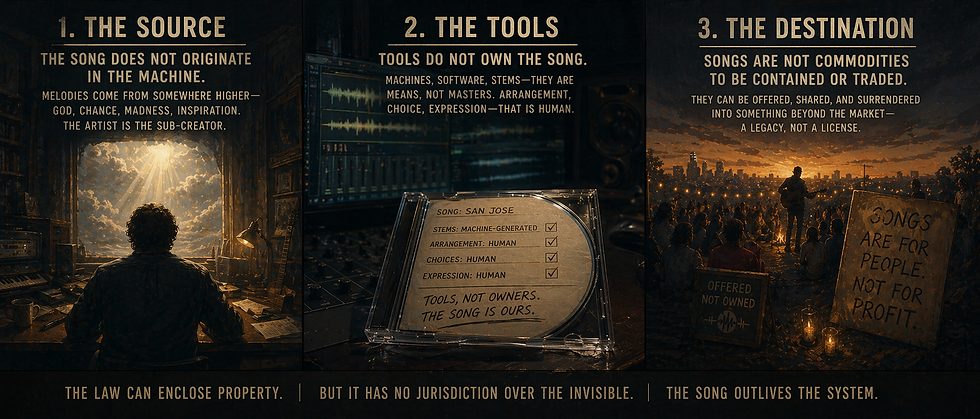
San Jose paid for the recordings.
San Jose used machine tools without conceding authorship to the machine or the company behind it. He believed original ideas belonged to God, or to the people, or to whatever invisible place songs came from before men tried to own them.
The law refused any attribution upward, outward, public, or divine.
The Label came to buy what could not be allowed to spread.
Track seven caught the argument crossing from rights language into murder.
At 10:03 the next morning, Blue Suit and Gray Suit walked into Drop the Needle.
Blue Suit carried the briefcase. Gray Suit carried nothing visible. Across the street, under the striped awning opposite the store, Pike stood beside an unmarked sedan and watched the window through reflection rather than through glass.
Long enough for the reader.
Not long enough for rescue.
Blue Suit placed the briefcase on the counter.
“Mr. Revolver,” he said, “there appears to have been a misunderstanding regarding one of our assets.”
“Asset,” Sonny said. “That’s tender language for a dead man.”
Blue Suit’s mouth remained still.
“We are prepared to compensate you at full declared value.”
Sonny did not look at the money. Less signaled fear. More signaled leverage. The exact number signaled understanding.
“Fine,” he said. “Full declared value.”
He set the San Jose disc on the counter. Blue Suit set the case beside it. The latches clicked softly.
Ownership became ceremony.
Then Sonny looked at the three cups of coffee on the counter and said, “Funny thing. I poured one for me, one for whoever came to buy this back, and one for the police. Turns out I guessed too high on the law and too low on the company.”
Blue Suit’s mouth remained still.
Then Sonny said the thing that mattered.
“San Jose paid for his own recordings. Used your tools because he couldn’t afford a band. Decided that didn’t make you the author. Decided the rights belonged somewhere you couldn’t buy them cheap. God. People. Air. Pick your theology.”
He laid one hand on the briefcase.

“You came to explain distribution. Ownership. Forms. One of you got tired of talking. Track seven says the conversation stopped being legal.” He glanced once toward Pike’s reflection and back again. “No title on the track. No song. Just room, then the argument, then the hit. No vocals after that because nobody left in the room had a future.” He leaned closer by half an inch. “You people really should stop putting murder on physical media. It lasts.”
Blue Suit closed the briefcase.
“You have a valuable collection, Mr. Revolver.”
“That’s one word for history.”
Gray Suit moved.
The device in his hand flashed once in the low shop light before it touched the base of Sonny’s spine like a fang finding the exact right seam.
Then it entered.
Hands on the counter. Grip tightening. Jaw setting once. Breath caught and released wrong.
Blue Suit remained courteous.
“We call this Rewrite,” he said. “You know, people like you? You can just keep living. No pain, no pleasure, but still. Nice life.”

Gray Suit withdrew the instrument.
Blue Suit rested the case against his thigh and continued.
“Too many people go missing and it becomes a conspiracy. Communities trust recognizable custodians. Better to leave a man where his neighbors expect him.”
Outside, Pike did not move.
Blue Suit took the San Jose disc. Gray Suit opened the door. The clipped bell chain hung silent above them.
The next morning Drop the Needle opened at ten.
Mrs. Alvarez came in first and said, “Morning, Sonny,” as if nothing in the world had shifted at all.
He answered correctly. He still knew what was private church run, what was repress, what should be sold, and what should stay with the family. At eleven, Johnny wandered in with gossip about a Label kiosk replacing the old pharmacy.
“Good use of the space,” Sonny said.
Johnny stopped halfway through a laugh.
By noon, Sonny had helped a widow price garage demos, advised a neighborhood kid on what belonged at home rather than in circulation, and explained to a customer that The Label’s stewardship model had prevented more cultural loss than most people understood.
He sounded like himself.
That was the horror.
Whether Sonny was any different was, wholly, irrelevant. For the history books would write of a place named Drop the Needle, ran by someone named Sonny whom you will never meet.
Later, under the low blue hum of the back neon, he ran a thumb along a devotional reissue and said almost tenderly, “The Beast gets a bad reputation.”
Johnny looked up from the counter display. “Sonny really likes the Label’s new vibe.”
Once you’ve proven that you can steal someone’s life, through murder, that no longer is enough. It becomes about how one captures the soul. The prisons that we create for ourselves are enough to drive any man wild from the craze of the beast. In Sonny’s situation, maybe his life WAS ultimately better, and maybe he did in fact serve some greater purpose in the scheme of things. Hard for me to say.
And in that meritocratic system, the beast did not bother to dispose of Sonny’s remains.
Like the Story You Just Read?
Consider Supporting the Artist on Patreon, or Share the Story


Comments